Table of Contents
- Quick Comparison Snapshot
- Factor 1: Fuel Availability and Price in Your Region
- Factor 2: Environmental Regulations
- Factor 3: Initial Investment vs. Operating Cost
- Factor 4: Space Requirements
- Factor 5: Maintenance Complexity
- Decision Checklist
- EPCB: Your Partner in Energy Transition
- Ready to Optimize Your Steam Production?
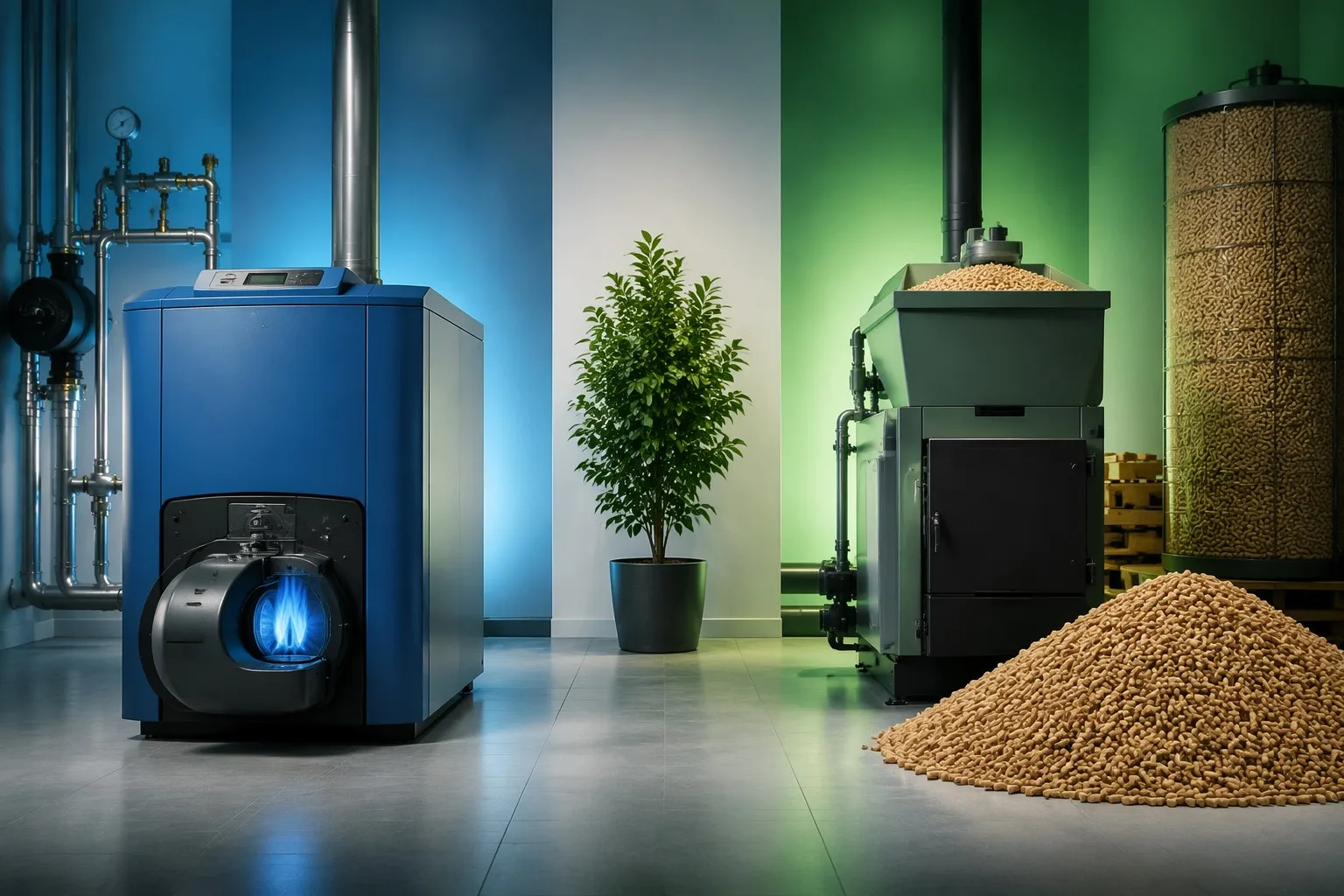
The global push for decarbonization and the volatility of energy prices have forced industrial facilities to re-evaluate their thermal energy sources. For many, the choice boils down to two heavyweights: **Natural Gas** and **Biomass**. While gas is the traditional favorite for its convenience, biomass is gaining ground as a carbon-neutral alternative. But which one is right for your specific plant?
Quick Comparison Snapshot
| Feature | Gas Boiler | Biomass Boiler |
|---|---|---|
| Automation | Very High | Medium to High |
| Initial Cost | Lower | Higher |
| Fuel Cost | Market-dependent | Often Lower (Local) |
| Emissions | Clean (CO2) | Carbon Neutral (Ash) |
| Space Needed | Minimal | Significant (Storage) |
Factor 1: Fuel Availability and Price in Your Region
The number one rule of boiler selection: **Choose the fuel you can get easily and cheaply.** Natural gas relies on pipeline infrastructure. If your facility is in a remote area without gas lines, the cost of trucking in LNG (Liquefied Natural Gas) can be prohibitive. Conversely, biomass (pellets, wood chips, rice husks, or bagasse) is ideal if you are in a region with high agricultural or forestry output. If your own plant produces organic waste, a biomass boiler essentially provides "free" fuel.
Factor 2: Environmental Regulations
Local and national laws play a massive role. In many regions, biomass is considered carbon-neutral because the CO2 released during combustion is equal to the CO2 absorbed by the plants during growth. This can exempt you from carbon taxes. However, biomass boilers require more sophisticated dust removal (like bag filters or electrostatic precipitators) to control particulate matter. Natural gas is cleaner in terms of particulates and SOx, but is a fossil fuel subject to carbon pricing.
Factor 3: Initial Investment vs. Operating Cost
This is the classic CAPEX vs. OPEX tradeoff. Gas boilers are relatively simple machines, meaning they are cheaper to buy and install. A biomass boiler system is much more complex, requiring fuel conveyers, feed systems, and ash handling equipment, making the initial investment 2x to 3x higher than a gas system. However, the lower cost of biomass fuel often means that the "payback period" for the higher initial cost is achieved within 2 to 4 years of operation.
Factor 4: Space Requirements
A gas boiler is compact. The fuel arrives through a pipe. A biomass boiler system requires a massive footprint. You need a fuel storage warehouse (silo or bunker), space for delivery trucks to maneuver, and a conveyor system to transport the fuel to the boiler. If your plant is in a crowded urban industrial zone, biomass might not be physically possible.
Factor 5: Maintenance Complexity
Gas is "fire and forget." Aside from annual inspections, maintenance is minimal. Biomass is "hands-on." You must manage ash removal, clean the grates regularly, and maintain the mechanical fuel handling systems. While modern biomass boilers are highly automated, they still require more man-hours for upkeep than gas units.
Decision Checklist
Ask yourself these four questions:
- Is there a natural gas pipeline within 500 meters of my facility?
- Do I have access to reliable biomass fuel (wood, husk, etc.) within a 100km radius?
- Does my site have 500+ square meters of extra space for fuel storage?
- Am I subject to high carbon taxes or fossil fuel penalties?
The Verdict
Choose Gas if you prioritize convenience, have a small footprint, and low initial capital.
Choose Biomass if you want to be carbon-neutral, have access to cheap fuel, and are looking for the lowest long-term operating costs.
Need Professional Boiler Advice?
Contact EPCB for a free consultation on selecting the right industrial boiler for your specific application.
Speak with an EngineerEPCB: Your Partner in Energy Transition
EPCB Boiler is a global leader in both gas and biomass technology. Our WNS series gas boilers offer industry-leading efficiency, while our SZL and DZL series biomass boilers are renowned for their robust design and ability to handle various fuel types. We don't just sell equipment; we provide expert consultation to help you run the numbers and choose the solution that maximizes your ROI.
Ready to Optimize Your Steam Production?
EPCB engineers are standing by to design a boiler system tailored to your local fuel availability and budget.
Contact Our Experts View Success Stories