Table of Contents
What is Hydrostatic Testing and Why is it Critical?
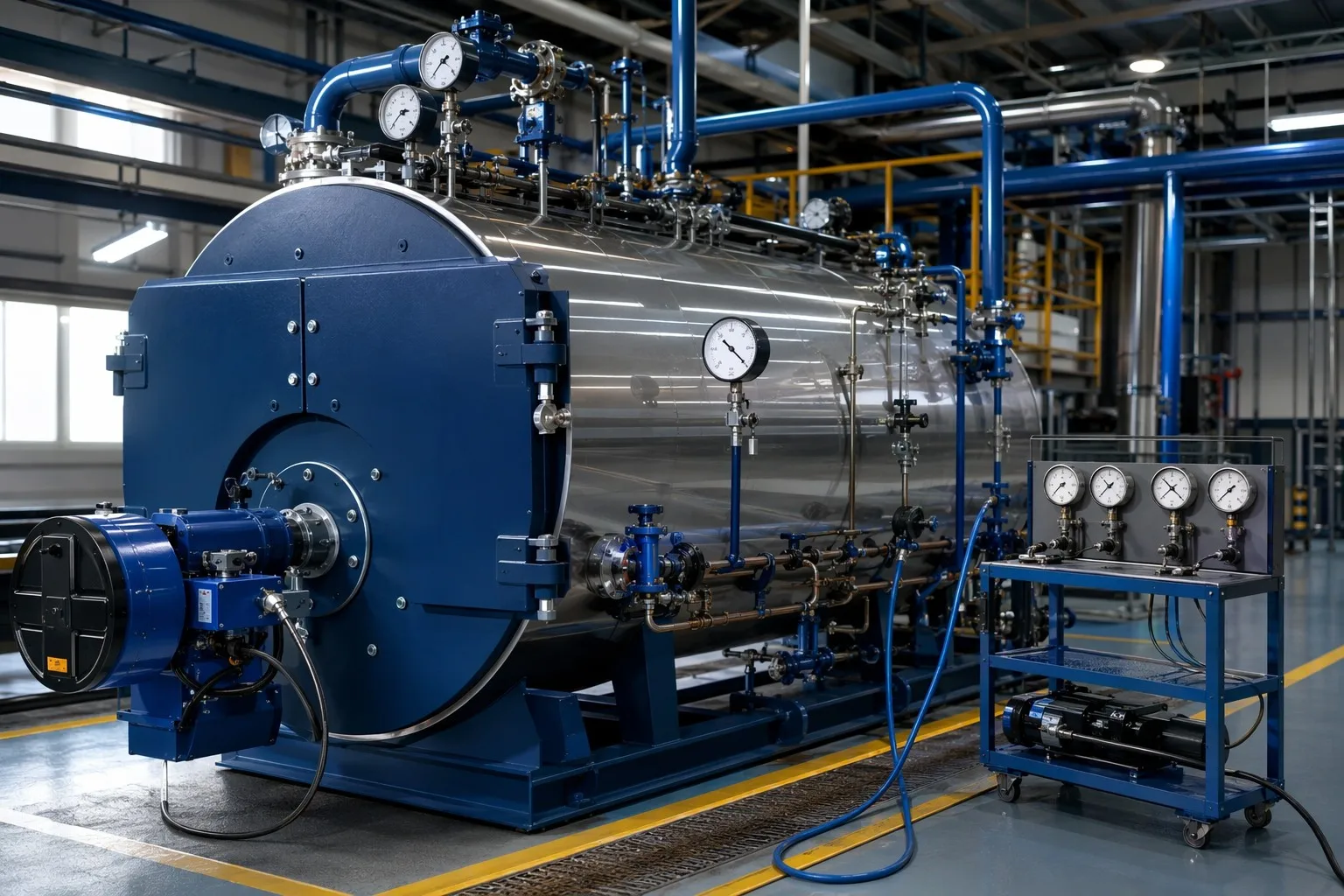
A hydrostatic test, often simply called a "hydro," is a way in which pressure vessels such as boilers, pipelines, and cylinders can be tested for strength and leaks. The test involves filling the vessel with a liquid, usually water, and increasing the pressure to a specified level. Because water is nearly incompressible, a hydrostatic test is much safer than a pneumatic test (using air), which can cause a violent explosion if the vessel fails.
The primary purpose of the test is two-fold: first, to ensure that the vessel can safely withstand its maximum allowable working pressure (MAWP) plus a significant safety margin; and second, to identify any leaks at joints, welds, or fittings. In the industrial boiler world, hydrostatic testing is the "final exam" for the boiler's pressure-retaining components.
The Hydrostatic Test Procedure Step-by-Step
Conducting a hydrostatic test requires precision and strict adherence to protocol. A typical procedure involves the following stages:
1. Preparation and Isolation
The boiler is completely isolated from the system. All valves except for the vents and the water inlet are closed. Safety valves must be either "gagged" or replaced with blind flanges because the test pressure will exceed the safety valve's set pressure.
2. Filling and Venting
The boiler is filled with water. The water temperature should typically be between 70°F (21°C) and 120°F (49°C). If the water is too cold, the metal may become brittle; if too hot, thermal expansion can skew results. As the water fills, air is bled out through the high-point vents until only water emerges.
3. Pressurization to 1.5x MAWP
A specialized high-pressure pump is used to gradually increase the pressure. According to most standards, the pressure is raised to **1.5 times the Maximum Allowable Working Pressure (MAWP)**. This extra pressure ensures there is a safety buffer during normal operation.
4. The Hold and Inspection Phase
Once the target pressure is reached, the pump is disconnected or valved off. The pressure is held for a specified duration (typically 30 minutes to 1 hour). During this time, inspectors visually examine all welds, seams, and connections for signs of "weeping" or moisture. Any drop in the pressure gauge reading indicates a leak that must be addressed.
When Should a Boiler be Hydrotested?
Hydrostatic testing is not a daily occurrence, but it is required at several key milestones in a boiler's lifecycle:
- New Boiler Construction: Every new boiler must pass a shop hydro-test before leaving the factory.
- Major Repairs or Alterations: If any welding is performed on the pressure-retaining parts (like replacing tubes or repairing the drum), a hydro-test is required to verify the integrity of the new welds.
- Periodic Inspection: Many jurisdictions require a hydrostatic test every few years as part of the state or insurance inspection cycle.
- Post-Installation: After the boiler is piped into a new facility, a site hydro-test ensures the field welds and connections are sound.
Standards: ASME Section I Requirements
For power boilers, the **ASME Boiler and Pressure Vessel Code (BPVC) Section I** is the gold standard. It outlines specific rules for the materials, design, and testing of boilers. Section I dictates the test pressure (typically 1.5x MAWP) and requires that the test be witnessed by an Authorized Inspector (AI). Failure to follow ASME protocols can result in the loss of the boiler's "S" or "U" stamp, rendering it illegal to operate in most regions.
Critical Safety Precautions During Testing
Even though water is safer than air, high pressure still carries risks. Operators must follow these safety rules:
- Clear the Area: Only personnel directly involved in the test should be near the boiler.
- Use Calibrated Gauges: Always use two calibrated pressure gauges to ensure one isn't giving a false reading.
- Gradual Pressure Release: Never release pressure suddenly. It should be bled off slowly through a controlled valve.
- PPE: Full personal protective equipment, including face shields and heavy gloves, is mandatory.
EPCB's Commitment: 100% Tested for Peace of Mind
At EPCB Boiler, safety isn't just a department—it's the foundation of everything we build. Every industrial boiler that leaves our facility has undergone a rigorous hydrostatic test witnessed by our internal QA team and third-party inspectors. We don't just meet the standards; we exceed them. When an EPCB boiler arrives at your facility, you can be 100% confident that it is built to last and engineered for safety.
Technical Documentation
All EPCB products come with a complete "Birth Certificate," including the signed hydrostatic test reports and material mill certificates. We believe in total transparency for our clients.
Need Professional Boiler Advice?
Contact EPCB for a free consultation on selecting the right industrial boiler for your specific application.
Speak with an EngineerBuilding a Safer Boiler Room
Trust EPCB for high-performance industrial boilers engineered to the highest global safety standards.
Speak to an Engineer Explore Solutions